


By Yıldıran Acar, Political Scientist
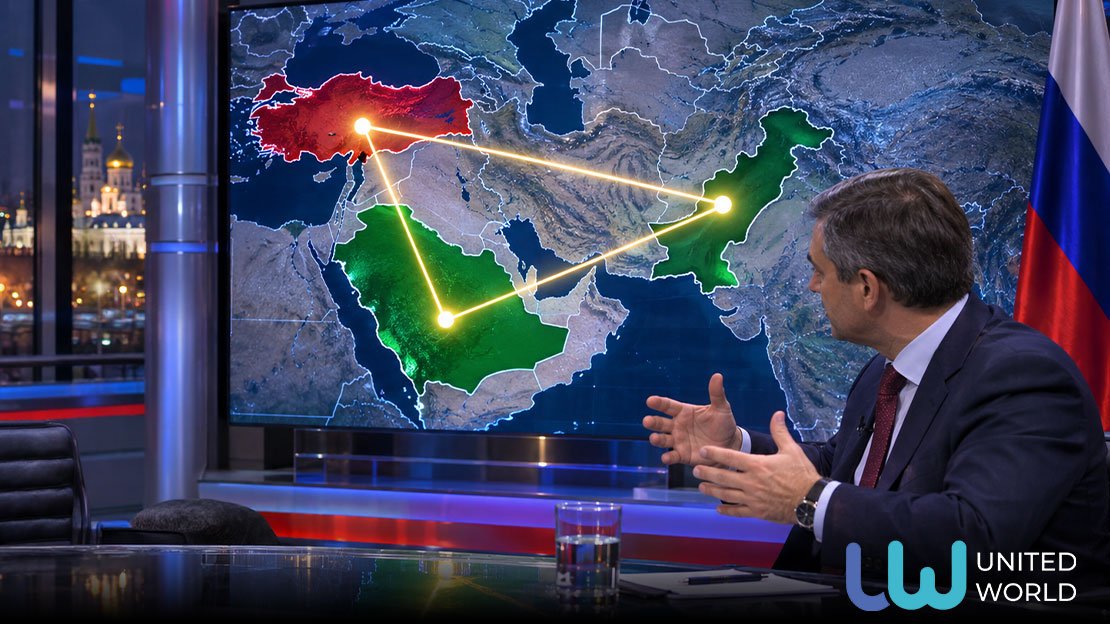
The Mecca Agreement, signed on 7 August between Türkiye, Saudi Arabia and Pakistan, is being discussed in the Russian media within the context of the Middle East’s changing security architecture. The key perspective emerging from Russian experts’ assessments is that the three countries are seeking to act more independently on regional security matters.
Kirill Semenov, an expert at the Russian Council on International Affairs (RSMD), interprets the agreement as an attempt to fill the vacuum created by the weakening of the US’s security role in the region. According to Semenov, the new framework could enable Sunni countries to act with greater autonomy in the security sphere and secure a more influential position within the regional balance of power.
Nikolay Sukhov, a researcher at the Primakov Institute of World Economy and International Relations (IMEMO), draws attention to the concrete advantages the agreement could offer the parties involved. In Sukhov’s assessment, Saudi Arabia, with its financial resources and political clout; Türkiye, with its military capabilities and defense industry; and Pakistan, with its large army and nuclear status, constitute the different elements of this cooperation. For this reason, the agreement can be seen not only as a political rapprochement but also as an attempt to bring together the parties’ complementary capabilities.
Distancing from the ‘Islamic NATO’ assessment
Another issue highlighted by Russian experts is whether the agreement will evolve into a NATO-like military alliance.
Sukhov points out that the principle of an attack on one member being deemed an attack on all cannot, on its own, be regarded as equivalent to NATO’s Article 5. In his view, mechanisms such as joint command, military planning, infrastructure and procedures for the use of force have not yet been established. Furthermore, the three countries’ perceptions of threat differ: Pakistan’s priority is India; Saudi Arabia’s is Gulf security and threats originating from Iran; whilst Türkiye’s security agenda extends across a broader geographical area.
Grigory Lukyanov, a researcher at the Institute of Oriental Studies of the Russian Academy of Sciences and an expert at the Valdai Club, views the agreement as a deterrence mechanism rather than a military bloc established against a specific country. According to Lukyanov, the parties’ aim is to ensure that regional actors reassess their security calculations by forming a collective force.
Are Israel and Iran the targets?
There is no common or definitive conclusion among Russian experts regarding whether the agreement was established specifically against Israel or Iran.
Lukyanov emphasizes that it cannot be said the parties intend to use their military capabilities against a specific country. Lyudmila Samarskaya, a researcher at IMEMO, also notes that the agreement does not constitute a direct military threat to Israel. However, Samarskaya assesses that the new security framework could serve as a warning to Iran.
These views indicate that Russian experts do not interpret the Mecca Agreement as a one-sided anti-Israel or anti-Iran alliance.
A new regional actor from Moscow’s perspective
The Mecca Agreement also raises the possibility, from Russia’s perspective, of the emergence of a new regional security hub. The institutionalization of defense cooperation between the three countries signals an era in which regional actors in the Middle East may take greater initiative.
However, in the assessments of Russian experts, the key factor determining the agreement’s impact lies not so much in the text of the agreement itself as in its capacity for implementation.
The establishment of joint defense mechanisms, the development of military coordination and the reconciliation of differing security priorities will determine the agreement’s future.
For this reason, the Mecca Agreement currently stands out not so much as a new military bloc, but rather as a significant initiative aimed at the redistribution of security responsibilities amongst regional actors in the Middle East.