


By Orçun Göktürk, from Beijing / China
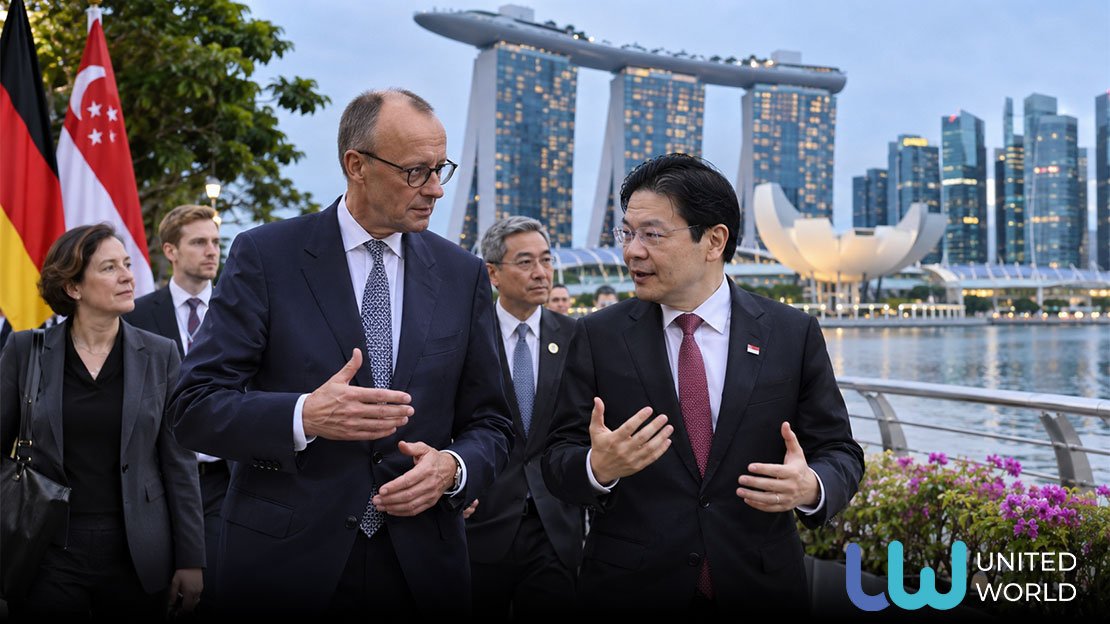
Germany’s two leading figures have embarked on separate visits to Asia within a matter of days. German President Frank-Walter Steinmeier paid a five-day visit to China from October 27 to 31. Meanwhile, German Chancellor Friedrich Merz undertook a five-day Asian tour from October 26 to 30, visiting Singapore, Japan and South Korea. His engagements in Tokyo were particularly noteworthy in terms of Germany’s Asia-Pacific strategy.
At first glance, these visits may appear unrelated. Yet they share a common underlying meaning: Europe is seeking new room for maneuver in a changing world order. At a time when the United States is increasingly resorting to economic and security pressure, China’s economic and technological weight is growing, and Asia is strengthening its central position in the global economy, Europe is being compelled to redefine its own interests.
In his book ‘World Order’, Henry Kissinger examined Europe’s future and the balance of power in Eurasia from the perspective of US strategic interests. One of Kissinger’s fundamental strategic concerns was the possibility of Europe emerging as an independent power center outside the Atlantic alliance, thereby weakening American influence across Eurasia. A closer strategic relationship between Europe, China and Russia would undoubtedly represent a major geopolitical challenge for Washington. As Kissinger put it, “Europe pursuing strategic autonomy or moving closer to the China-Russia camp would be a disaster for Washington.”
Today’s developments are bringing this debate back to the forefront. Can Europe move beyond the boundaries set by the United States? Or will its turn towards Asia become another component of Washington’s global strategy?
The Ukraine war has pushed Europe into a dead end
To understand Europe’s current search for alternatives, we need to look at the war in Ukraine. Since 2022, Germany has largely aligned itself with the NATO position led by the United States. It joined sanctions against Russia, provided extensive military and economic assistance to Ukraine, and brought its relations with Moscow to one of their lowest points in history.
This policy has had particularly severe economic consequences for Germany. Its industrial model, which had relied heavily on Russian energy resources, was forced to undergo a major transformation. Energy costs, competitiveness and the future of German industry have become some of the country’s most pressing economic challenges. Berlin, which once regarded economic cooperation with Russia as an element of European security, has now moved towards a position of confrontation with Moscow.
The German government’s approach, which prioritizes military support for Ukraine, has been one of the factors contributing to diplomatic solutions being pushed into the background and the prolongation of the war. While Europe has sought to force Russia into retreat through economic and military pressure, it has also made substantial concessions at the expense of its own economic interests.
However, the prolongation of the war has not reduced Europe’s security dependence on the United States. On the contrary, Europe’s dependence on Washington in terms of its own defense capabilities and foreign policy decisions has once again become a subject of debate.
When the protectionist policies pursued by the United States in its trade relations with Europe are added to this equation, seeking new partnerships is no longer merely an option for Berlin and other European capitals. It is increasingly becoming an economic necessity.
China: partnership or competition?
Germany’s China policy is one of the clearest examples of this contradiction. In 2025, China overtook the United States to become Germany’s largest trading partner once again, making it an indispensable market for German industry. Bilateral trade between Beijing and Berlin exceeded 250 billion dollars in 2025 (according to figures released by China’s Ministry of Commerce, the figure was 217 billion dollars; the difference stems from the two countries’ different statistical recording methods). The presence of German automotive giants such as Volkswagen, BMW and Mercedes-Benz in the Chinese market demonstrates the scale of the economic relationship between the two countries. China’s enormous 1.5-billion-dollar market is of indispensable importance to Berlin.
At the same time, Germany and the European Union have increasingly come to define China as an economic competitor in recent years. The European Commission’s three-part description of China makes this clear: China is simultaneously a cooperation partner, an economic competitor and a systemic rival for Europe.
This approach has produced tangible consequences.
In 2024, the European Union began imposing additional countervailing duties on electric vehicles manufactured in China. Manufacturers such as BYD, Geely and SAIC were affected by these measures. Germany had approached the tariffs with reservations, taking into account the interests of its own automotive companies in the Chinese market. Nevertheless, the decision was adopted at the EU level.
Another important example concerns the telecommunications sector. Germany has decided to gradually remove critical components supplied by Huawei and ZTE from its 5G infrastructure. Under agreements reached between the German government and mobile network operators, critical components supplied by these companies are to be removed from 5G core networks by the end of this year. Critical management functions in access and transport networks are also scheduled to be replaced by the end of 2029.
Europe’s restrictions on China do not end there. An EU regulation concerning the participation of Chinese-origin medical devices in public procurement excludes Chinese companies from tenders worth more than five million euros and limits the share of Chinese-origin products in the relevant contracts to 50 per cent.
All these developments demonstrate how partnership rhetoric and competitive policies coexist in Germany’s relations with China. Berlin does not want to give up the Chinese market, but it also regards China’s technological and industrial rise as a threat to its own economic superiority.
Steinmeier’s message: Dialogue and strategic partnership
Steinmeier’s visit to China was an important diplomatic step demonstrating that Germany does not want to sever its relations with Beijing. The German President, making a state visit to China for the first time in approximately eight years, held meetings in Anhui and Beijing. In addition to Chinese President Xi Jinping, he met Premier Li Qiang and Zhao Leji, Chairman of the Standing Committee of the National People’s Congress.
Naturally, the most important meeting of the visit took place with Xi Jinping on October 30.
Xi emphasized that China and Germany, as the world’s second- and third-largest economies, bear significant responsibilities for global economic stability and the development of China-Europe relations. He stated that the two countries should establish a new model of cooperation based on equality, mutual benefit and strategic stability.
Two points in Xi’s message were particularly noteworthy. First, he stated that China supports Germany playing a more active role in European and international affairs. Second, he called on Germany to adopt a more open, rational and pragmatic approach towards China’s development and economic cooperation with China. Beijing, of course, continues to pursue its strategy of pulling the European Union away from Washington.
While expressing China’s support for German companies expanding their operations in the Chinese market, Xi also called on Germany to provide Chinese companies with a fair, transparent and non-discriminatory business environment. Artificial intelligence, green transformation, the digital economy and trade in services were highlighted as future areas of cooperation.
Steinmeier, for his part, expressed appreciation for China’s economic, scientific and technological development in recent years. He reiterated Germany’s commitment to the One-China Policy and stated that the two countries could resolve their economic and trade disputes through dialogue.
Another issue that stood out in the German President’s remarks in Beijing was the international order. Steinmeier stated that the international system was under pressure and that the world expected China to assume a greater role. He called for adherence to the principles of the United Nations Charter, international law, free trade and World Trade Organization rules. He advocated joint action against protectionism and trade wars.
However, the visit also had another dimension. In his speech at Peking University, Steinmeier argued that China’s policy of economic self-sufficiency should not create dependency and vulnerability in other countries. He also drew attention to the trade imbalance between China and Europe. Thus, while Berlin continues dialogue with Beijing, it is also keeping its objections regarding economic competition firmly on the table.
Merz’s visit to Japan
Chancellor Merz’s Asian tour, which began around the same time as Steinmeier’s visit to China, reveals Germany’s broader strategic efforts towards the region.
During his five-day tour, Merz visited Singapore, Japan and South Korea. The Japanese leg of the tour was particularly significant. Meeting Japanese Prime Minister Sanae Takaichi in Tokyo, Merz stressed the need for the two countries to deepen cooperation in economic security, defense and technology. It is worth remembering that under Takaichi’s leadership, Tokyo has adopted a more hawkish and openly anti-Beijing stance.
Following the talks, the two sides agreed on a joint declaration on economic security and a package of measures aimed at strengthening cooperation. Reducing dependencies in critical supply chains, defense industry cooperation, artificial intelligence dialogue and joint initiatives in advanced technologies were among the issues discussed.
Defense cooperation also featured prominently during Merz’s visit to Japan. The two countries agreed to explore joint projects in defense production, particularly cooperation in military equipment. Other agreed areas included the resumption of intergovernmental consultations in 2027 and Japan becoming the partner country at the 2028 Hannover Industrial Fair.
Another noteworthy aspect of Merz’s statements was the establishment of a stronger economic network between Europe and Asia. The German Chancellor argued that Europe should work more closely with countries such as Japan, Singapore and South Korea in addressing global trade imbalances. He also raised the possibility of restarting negotiations on a trade agreement between the European Union and ASEAN countries.
Merz’s assessment at the end of his tour in South Korea summarized Germany’s approach: European and Asia-Pacific countries are seeking to develop stronger cooperation in order to protect their common interests in an increasingly uncertain world, where American hegemony is in decline.
There is an important detail here. The question is whether the relationship Merz is seeking to establish with Japan and South Korea amounts to the declaration of an explicitly anti-China alliance. The recent participation of these two countries in NATO summits has caused considerable concern in Beijing. Meanwhile, the Atlantic alliance, having become increasingly detached from production after 45 years of neoliberal policies, is continuing its efforts to reduce dependence on China through economic security, technology, defense and supply chain policies.