


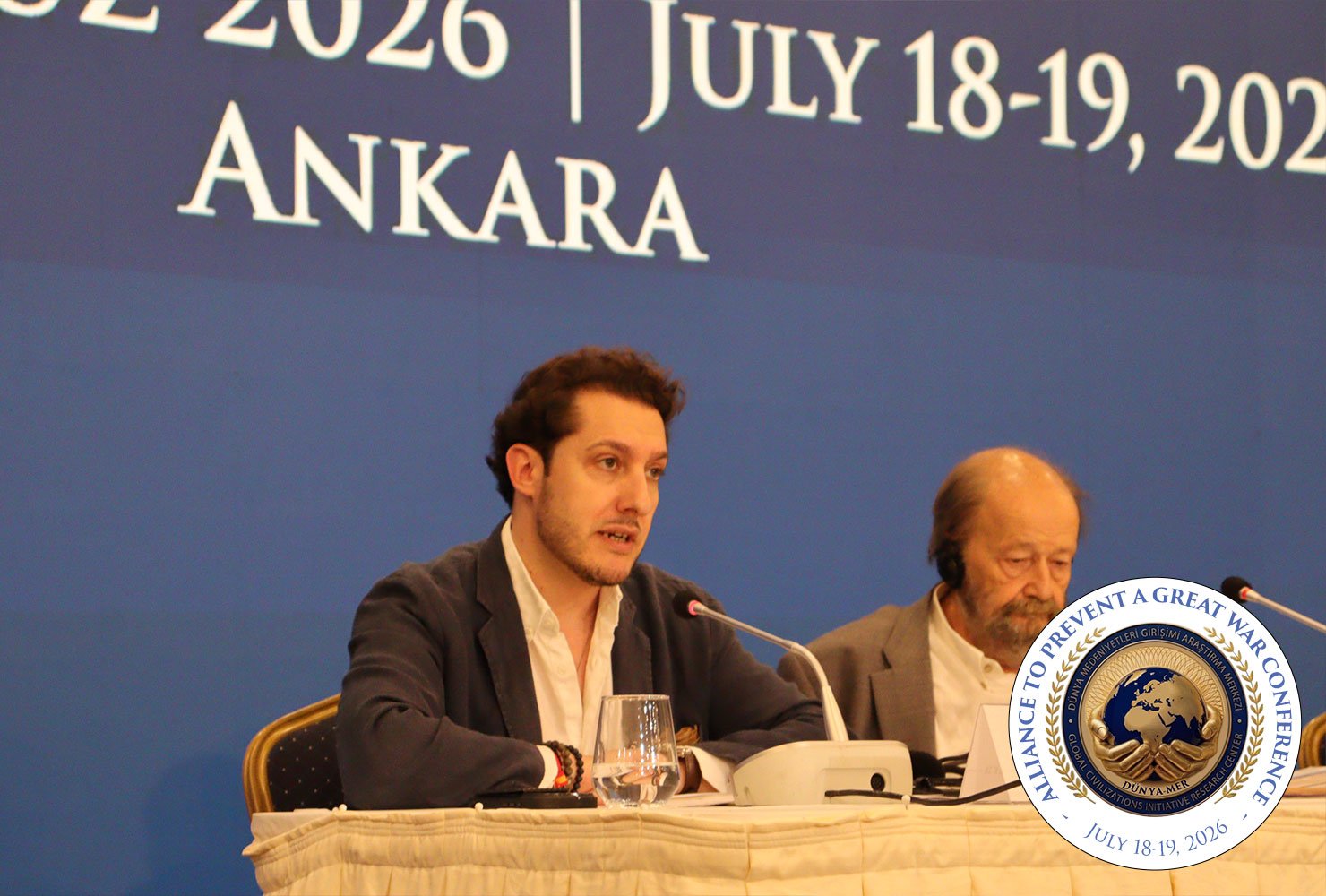
By Javier Hurtado Mira, Chairman at Democrat Youth Community of Europe (DEMYC)
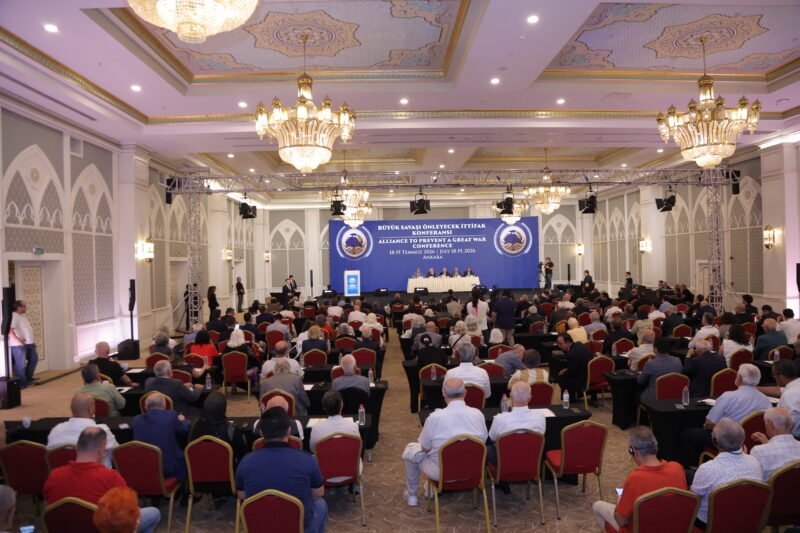
The international conference entitled “The Alliance to Prevent a Great War,” organized by the World Civilizations Initiative Research Center, was held at the Meyra Palace Hotel in Ankara on 18–19 July 2026.
UWI will present the speeches held on the conference during the coming days.
The conference, which featured presentations by speakers from Azerbaijan, Belarus, France, Germany, Greece, Iran, Italy, Japan, Russia, the Sahrawi Arab Democratic Republic, South Africa, Spain, Switzerland, the Turkish Republic of Northern Cyprus (TRNC), Türkiye, the United Kingdom, and the United States, was attended by approximately 200 distinguished invited guests.
Ministers, members of parliament, ambassadors, retired generals, scholars, politicians, diplomats, military officers, and experts examined the question of the “Alliance to Prevent a Great War” from a wide range of perspectives.
Below, we present the speech of Javier Jurtado Mira. The title was set by UWI.
Hello everyone. It feels wonderful to be here with you today. I would like to thank the organizers for giving us the opportunity to be together. I might be the youngest member at this table right now. I am genuinely very happy to be with you, because it is always a immense challenge to be able to access these kinds of spaces.
Especially as Westerners and Europeans, while we can easily attend any conference in Brussels, the moment you step outside the European Union, you can easily be labeled in a different way. That is, inviting Americans to dialogue, inviting Europeans to dialogue… Doing these in regions outside of Europe is not easy at all. As long as people continue to talk and remain open to one another, rather than hurting each other or starting wars, we can also remind the world how much safer a place it can be when we move forward with such approaches.
We have a wonderful moderator. We have a Greek moderator. The last time we had a Greek moderator, the Trojan War broke out between Asia and the West and lasted for 10 years. But now, I will try to keep my speech brief so that we do not experience such a problem.
Now, it is also very nice to be in Ankara. Of course, as Westerners, if you recall during the Clash of Civilizations era, we witnessed political propaganda being used at home on television. That is one part of the story. As you travel more, gain more experience, and advance in academia, you begin to see that the world is far more complex than what you are shown, and that perhaps you were miseducated at home or at school. Or you can see that you were misled by European political figures and leaders. Unfortunately, we suffer from a lack of a political class. There is a lack of a political class in the West. When you attend national and international conferences and gather with your colleagues, you can see this very clearly. Some of your colleagues suffer from a lack of knowledge and a lack of experience, and this is not the case everywhere.
For example, how was it in the past? There were political figures on the left, on the right, and in the center; they could all sit together. They could reach a consensus together. Even when they had major political disagreements or were engaged in wars, they would conduct politics in a normal manner. But nowadays, we are being misled in a completely different way under the governance of a political bureaucracy, under Brussels. And when people call you or when you write in newspapers, you call it the “Brussels Bubble.” Yes, it really is. It is said that decision-making processes in the European Union continue to be centralized in Brussels without the genuine participation of every citizen in the European Union, and this is true. Unfortunately, because Brussels politicians lack a political agenda, they comply with America’s orders at the expense of European Union sovereignty. This is a great shame, a pitiable situation. Because our American friends, unfortunately, have no respect for our sovereignty either. Supposedly, we are their allies, and we are members of the Transatlantic agreement. In other words, it is also possible for us to make criticisms regarding NATO here.
If you ask, “What is the meaning of NATO today?”, the situation is different for people of my generation. We know NATO more from history, don’t we? The Soviet Union collapsed, and afterwards, people came together for NATO. They pondered, “Should we unite again, or should we dissolve?” Many people, those involved in national politics, and those who consider themselves a military alliance in military matters, might also say: “European leaders do not possess great power or decision-making authority over what will be done in NATO.” Anyone can say this.
For example, in NATO in 1982, under the government of Felipe González, a referendum was demanded without consulting anyone, and the question “Should we leave NATO?” was asked for the first time after a change in party leadership. Because it was argued that “This situation would bring instability, it would be a bad decision, let us not leave.” That is actually a poor reason. In that case, let us never hold elections, let us select no one, so that there is always stability! And the referendum was held in 1986; 54% voted in favor. So, if a vote were held today, what would people feel about this alliance, about NATO? I cannot say “This or that would happen,” but I am genuinely curious about the real opinions of citizens. Internationally, what would people say about being drawn into such a conflict, about NATO acting not as a defense alliance, but on the contrary, as a provocative organization? Understanding that would probably be a bit saddening.
For our generation, especially when we look at these wars in Ukraine and other regions, war is… well, as our Greek moderator would also remind us, what did Herodotus say? He said, “In peace, sons bury their fathers, but in war, fathers bury their sons,” and perhaps families are thinking about this right now. Now, won’t any of this have consequences in the world? Children are being drawn into these wars. Unfortunately, when we think about the political classes, none of the family members of those who declare wars participate in the wars they declare. I firmly believe that this is the case in Brussels, in Ankara, in Moscow, in Kyiv. Something needs to be rethought about this rising tension heading toward war for both sides… Because no one thinks about the consequences. It only affects those who die in this war; I think the younger generation suffers in this regard, while those in the higher echelons of politics are not affected very much. I think this is a situation that all of us need to reflect upon time and again. As people who energize the international atmosphere, we must rethink this. We should move a bit more calmly in different directions, more slowly, and try to reach our goals through more peaceful solutions.
So, how can we build an alliance here to make people stop war all over the world? We need to invest in young people here. This is already a new trend; perhaps a very common trend that everyone has heard of. Many young people are also participating here voluntarily. Some are participants, some are members of political parties or members of various organizations. Only in this way can things change. Certain generations already carry the burden of a massive historical crime. That is, our history is a great teacher, but sometimes it can also be a heavy, massive burden to carry upon ourselves. We can carry the impact of certain conflicts. This does not mean: “Let us invest in the new, let us forget the past.” No, it does not mean that. But perhaps in terms of forgiving others, in terms of forgiving ourselves, I think moving forward will always be a good thing.
This is also important: In 2002, we had a military speaker from Italy when Berlusconi was prime minister. At that time, a NATO-Russia Summit was held near Rome together with President Putin and President Bush, and here, not 19, but around 20 people in the NATO Council decided on when Russia could participate. There was talk that a new reform was probably needed to create a new NATO, a more peaceful NATO. Not the dissolution or breakdown of NATO, but still, NATO becoming better might be happy news for some. In other words, when there are great powers, you will be able to reach as far as China. When you take such military allies by your side, no one will be able to provoke each other anymore, because they will be part of the same organization. This might be a very optimistic wish, as the Americans say, but sometimes thinking about good things makes a person feel good. In order to move forward from these kinds of issues, we need to look at a different direction of the political spectrum. We need people who will not just follow Brussels’ orders, but people who think differently.
Of course, I possess a humanistic optimism. I am not overly optimistic, but still, for the next few years, I do not expect much change in the upcoming elections anywhere. That is, I do not have great expectations from center-right or center-left politicians. You might ask about Spain: “How is my country putting up resistance? How is it resisting NATO raising this share of gross domestic product from 2% to 5%? Especially, how is it standing against those selling weapons to America?” You might say. The Spanish government decided that this money could probably go to a much better place; it decided that it could go to social relations, education, or infrastructure. That is, it thought it could not be used solely for military assets. I think that is genuinely very smart. Of course, you may not always agree with your president or prime minister on an ideological matter, but sometimes someone stands in such a correct position on certain issues that you need to support them there as well.
I also believe this: Politically, we are currently not very close to communist ideology, but as an organization, internationally, we are currently closer to all those on the side of peace. We are closer to those trying to build bridges between different people and nations. We organize conferences in different cities across Europe; similarly, in the Middle East and North Africa, we always bring these partners together mutually. In a sense, we try to bring together even those who historically hated each other on a neutral platform, in a neutral place where no one can provoke anyone. Perhaps individuals who could not participate in any other political gathering are brought together for dialogue and political negotiation under peaceful conditions. Ultimately, of course, you can bring yourself to a consensus with others in a much smarter way; at least, I want to believe so.
There is also this: When we organize Erasmus programs, European programs regarding Eurasia, for instance, one of the speakers mentioned the Eurasian Council. As Western Europeans, we are already very open to this. We can sometimes forget: There was the Silk Road, wasn’t there? How historically important it was, how effective it was politically, and how much culture we received from Asian countries, how many things we learned. We have so many historical cities, and these cities mean a great deal to Europeans. When it comes to political perception, it is important that we can do business well with one another.
Along with this open door, it must also be said: We are by no means entirely naive. There will certainly be specific objections among Europeans. Of course, people can say: “Europe is dividing, Russia cannot be trusted, Türkiye is playing both sides.” All of these might be partially true, but at the same time, what are we doing right now? What are we doing to improve these conditions? What are we doing against all these countries that we think have nothing to do with us?
In the past, when people met in Vienna, everyone politically hated each other; they did not like one another. But what happened? Then a global war broke out, and those misunderstandings and antipathies among them grew even stronger. Actually, if you ask me, we can coexist without liking each other. We do not all have to love each other; in fact, perhaps that is the funny part of it. But if there is fear, or if we are aware that things are escalating militarily and a major war might break out in the coming periods, then we need to sit at the table and negotiate ways for us to coexist. But what happened when this liberal optimistic thought was placed at the end of history? Everything ended completely. In other words, we are still talking about conflicts. Sometimes in the West, we want to believe in certain bestsellers, top-selling books. Because bestsellers make it seem as if they hold everyone on a common ground and offer a solution to everyone. But most of the time, it is misleading.
I also believe that Türkiye will play a very important role in future international relations, and everyone in Europe knows this. That is why many Europeans here are also afraid of Türkiye. Historically, it has very good diplomats, career diplomats. In many negotiations, we have already seen the impact of these diplomats. And you also have your Mediterranean culture; it is a culture that we share with you from Spain. You are not only the heirs of Istanbul, of Byzantium, of Constantinople; every single one of these meets in the same city, all this history meets in the same city.
And what is the slogan in your country? “Yurtta sulh, cihanda sulh”—that is, “Peace at home, peace in the world.” For the future, I think you, the youth, represent a very important place that can spread this message to the world, to Europe, and to all international conferences. So, what do we understand from today’s situation? It is very important for Russia to be stable. Because a chaotic Russia would not be in favor of Europeans either. In other words, if we are a bit selfish as Westerners, we need to think of ourselves as well; we need a strong and stable Russia that suits our own comfort. We want a strong, stable structure in the Caucasus region; we would not want any chaos. Central Asia seems like a buffer zone, but it is not; they have their own history.
At the same time, there was a refugee or illegal migration crisis directed toward the European Union, and we want to prevent this. To be able to prevent this, we need a stable Russia and the Eastern Bloc countries, living hand in hand, side by side peacefully. We need a strong and respected Middle East. Of course, I also mentioned the importance of the initial Silk Road dimension here. We think that sometimes we worry too much politically. That is, the founders of our nations became this great by trading with each other; it did not happen thanks to great emperors, it happened through the interaction of great civilizations with one another. Perhaps we need to get a little closer to each other and look at each other more quietly. Here, when it comes to sovereignty, Europe must be sovereign, yes. This message is not very conformist or supportive of Brussels; we should not execute the orders given by Washington, we need to respect each other.
We should not repeat what the elites say in Europe, in Brussels. Because the majority does not elect these elites anyway; most of them are people who have reached these places through civil service levels over many years. This is not something brought about by true balance and equality. So, as a Spaniard, let me say this: I am someone who adopts the Mediterranean lifestyle a bit. You mentioned Greece, Türkiye, Italy, Cyprus… Our country… We know that many civilizations were born from the Mediterranean, grew from here, and developed from here. This should never be forgotten. Sometimes, when we talk to those in the north, with our German colleagues and so forth, they say: “Democracy is with us.” The Americans say the same thing: “We will bring democracy,” and so on. And I remind everyone: Northern Europeans were still eating with their hands while we were already using knives and forks. In other words, these come from very ancient Roman times, from very ancient times; these are important features we are proud of in the east.
Thank you very much. I hope my ideas and views have opened your horizons a bit, and I hope we discuss and talk even more. Thank you very much for listening.