


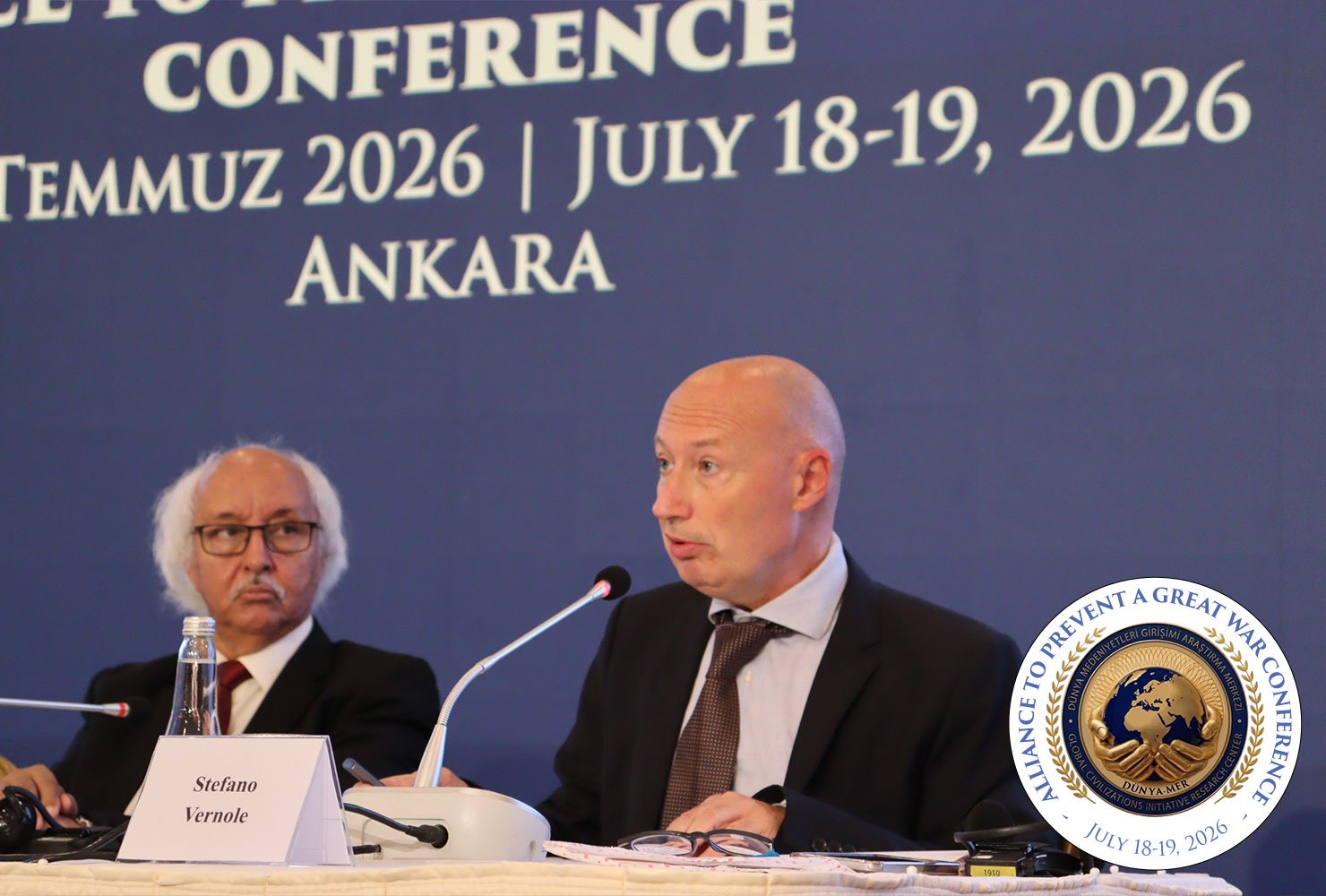
By Stefano Vernole, Deputy Director of the Eurasia and Mediterranean Research Center, Italy
The international conference entitled “The Alliance to Prevent a Great War,” organized by the World Civilizations Initiative Research Center, was held at the Meyra Palace Hotel in Ankara on 18–19 July 2026.
UWI will present the speeches held on the conference during the coming days.
The conference, which featured presentations by speakers from Azerbaijan, Belarus, France, Germany, Greece, Iran, Italy, Japan, Russia, the Sahrawi Arab Democratic Republic, South Africa, Spain, Switzerland, the Turkish Republic of Northern Cyprus (TRNC), Türkiye, the United Kingdom, and the United States, was attended by approximately 200 distinguished invited guests.
Ministers, members of parliament, ambassadors, retired generals, scholars, politicians, diplomats, military officers, and experts examined the question of the “Alliance to Prevent a Great War” from a wide range of perspectives. Below, we present the speech of Sefano Vernole, Deputy Director of the Eurasia and Mediterranean Research Center.
My presentation focuses on the military operations prepared by NATO in Europe regarding its conflict with Russia. NATO has actually increased its military presence, especially in terms of military operations. It maintains a presence in eight countries across its eastern flank—namely Bulgaria, Estonia, Hungary, Lithuania, Poland, and Slovakia.
Particularly noteworthy in recent days are the upcoming military movements and preparations being made, specifically involving British and French military forces against Russia. In relation to this, there are five primary operational actions:
Strengthening Europe’s military corridors.
Improving military transport and logistics.
Streamlining cross-border transit whenever force projection is required.
Establishing a dedicated military force.
Expanding the advisory capacity of these military forces.
Key Transport Corridors
There is a call for a single coordinator among member states to streamline and coordinate these military forces across Europe. As seen on the map:
The Baltic Sea Corridor: The first major transit route.
The Baltic–Black Sea–Aegean Corridor: The second and arguably most critical corridor. It connects Moldova and parts of Odesa (Ukraine) to Southern Europe and links these regional waters.
The Mediterranean Corridor: Vital for air and land force coordination and readiness.
In the publication released in March 2025 regarding European security and support for Ukraine, the importance of increasing NATO’s military forces is emphasized. In this document published by the European Union, there is a statement emphasizing the urgent need to simplify and harmonize regulations. This ensures military forces, units, networks, and resources can fulfill their responsibilities by swiftly deploying to necessary locations whenever a security vulnerability arises.
Focus is directed toward these priority corridors. The document highlights 500 critical infrastructure projects, including:
Expanding railway tunnels.
Reinforcing road and rail bridges.
Expanding port, harbor, and airport terminals.
Extending European transport corridors all the way into Ukraine.
To achieve this, the Commission recommends adopting a single standardized form across all member states and establishing a unified digital information system by 2030.
Potential Conflict Entry Points
Northern Axis: A corridor extending from Norway to Estonia.
Central Axis: A corridor encompassing Poland and Belarus.
Southeastern Axis: A corridor along the Romanian border.
Western Balkans & Mediterranean: Critical corridors in the event of a crisis involving Russia, with particular attention drawn to the Mediterranean route near Libya.
While the EU urges member states to reinforce infrastructure along these corridors to defend Europe, the initiative faces significant technical and political hurdles.
Technical Obstacles & Legal Frameworks
The issue of financial compensation for private railway and logistics companies has become a major point of friction, as warned by European Parliament negotiators.
Key issues expected to dominate negotiations on the Military Mobility Regulation include:
Emergency priority rules.
The Solidarity Fund.
Digital systems required to make the “Military Schengen” area operational.
During a press conference in Strasbourg, the European Parliament advocated for regulations to grant military shipments priority on railways and to mobilize private infrastructure and assets under the Solidarity Fund.
The European Parliament argues that emergency measures must cover the entire European Union—not just nations bordering crisis zones. Otherwise, a hostile actor could target a few border states while the rest of Europe remains bound by standard bureaucratic procedures. Therefore, the European Parliament maintains that no European nation should be left outside this system, advocating for necessary arrangements so that an attack on a few European countries triggers an intervention by all European countries.
Short-Term Developments & Digitalization
The European Parliament supports rapid digitalization of military transport permits and customs procedures.
The Digital Military Mobility Information System is set for early deployment, with a hard deadline of 2028.
This system will manage military transport permits, traffic routing, and customs under EU Form 302, remaining fully compatible with NATO’s LOGFAS (Logistics Functional Area Services) system.
Funding Deficits
In the next EU budget, funding allocated for military mobility will increase nearly tenfold to approximately €18 billion. However, experts warn that this amount remains insufficient to meet the needs of the 500 critical infrastructure points—let alone thousands of additional sites. Signals indicate a need for detailed mapping, increased budgets, and investments in additional sites.
Additionally, the European Parliament demands stricter rules for Solidarity Fund suppliers. It explicitly uses the phrase: “Long-term cooperation with companies linked to unfriendly nations must be avoided.” This clause directly targets Chinese-linked railway suppliers, equipment vendors, and logistics firms.
Post-Ankara Summit: European Commission Recommendations
Following the summit in Ankara, the European Commission issued several key recommendations:
Deepening Cooperation: Expanding joint efforts with NATO and other allies, recognizing Russia as a long-term threat to Euro-Atlantic security.
Flagship Military Mobility Efforts: Developing flagship military mobility initiatives with NATO, including joint desktop exercises starting in 2026.
New Regulatory Framework: Enabling member states to accelerate aid to Ukraine.
Military Mobility Transport Group: Establishing a unified group bringing together EU member states, the European Commission, the European External Action Service, and the European Defence Agency. Ukraine and European Economic Area countries will be invited as observers.
National Coordinators: Requiring each member state to appoint a single National Military Transport Coordinator to act as the sole point of contact for permits and notifications.
Chinese Diplomacy & Proposed UN Role
In parallel, China has submitted a proposal to the United Nations indicating its desire to participate in a UN mission to support peace in Ukraine:
China seeks a significant role in potential EU/UN peacekeeping missions in Ukraine.
It proposes a new global diplomatic architecture to reshape multilateralism, strengthening the role of the Global South.
Under its Global Civilization Initiative, China advocates for a new international order.
Beijing has declared its readiness to deploy troops to a peacekeeping force established under a United Nations mandate, believing this approach will facilitate international acceptance of a potential ceasefire.
During UN Security Council meetings, China continues its call for an immediate ceasefire, peace negotiations, and a stability plan that takes Moscow’s security interests into account. It emphasizes peaceful coexistence among different political systems, a multipolar world order, mutual respect, and equal global interaction.
On June 10, the Permanent Mission of China to the UN hosted a high-level event at UN Headquarters in New York for the “International Day for Intercultural Dialogue.” The theme was: “Exploring New Pathways for Intercultural Dialogue and Writing New Chapters for Global Governance.” The event was co-organized by the Permanent Representatives of Armenia, Colombia, Ethiopia, Greece, Indonesia, Iraq, and Mexico, alongside the UN Alliance of Civilizations and UNESCO.
With nearly 300 participants—including high-level representatives from various nations and UN officials—this event reiterated China’s explicit intention to assume an active role in a prospective peace settlement.