


By Ali Rıza Taşdelen
We are living through a period in which the collapse of the imperialist capitalist system is accelerating. Europe, particularly France, is facing serious economic and political problems.
Donald Trump, who failed to deliver on his promises to the American people, was punished at the ballot box, the Republican losing majorities in both the House of Representatives and the Senate to the Democrats. He is now called “lame duck”.
Trump came to power promising to end wars, but his military attacks on Iran alongside Israel took his warmongering to new heights. He suffered a major blow and was defeated. Let alone securing a victory, the war also triggered a global fuel crisis comparable to the 1974 oil crisis. Rising fuel prices have affected almost every aspect of daily life in the US and Europe.
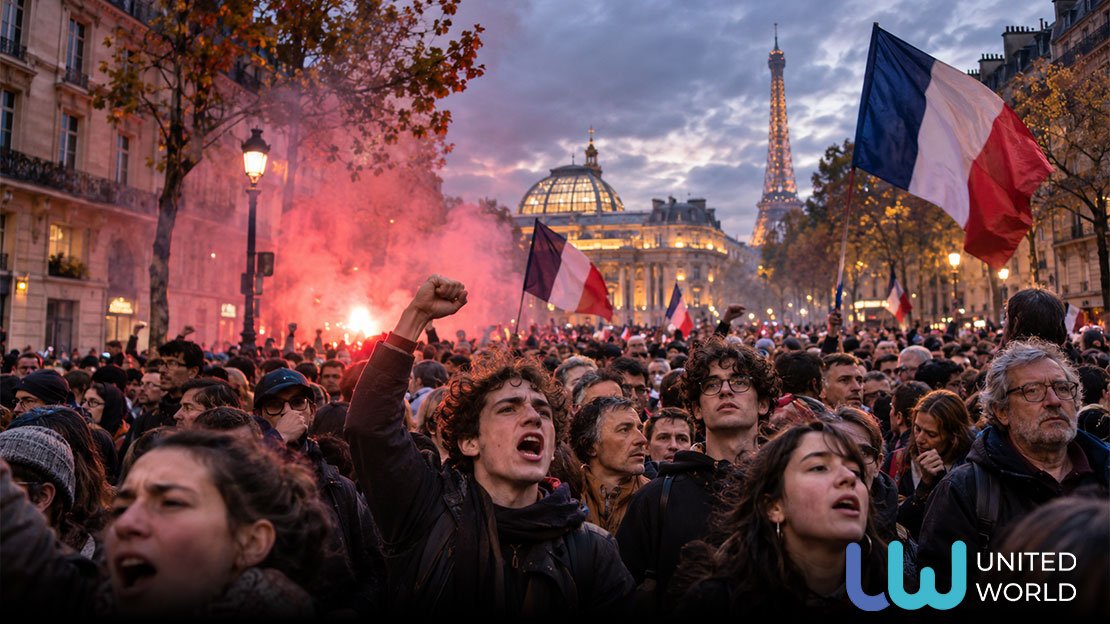
In Europe, meanwhile, people have risen up against the globalist governments responsible for the current crisis. Europe is witnessing historic events. The protests in France that began seven weeks ago with high school students have now spread to various sections of society. On October 17, 24 and 31, hundreds of thousands of workers, retirees and public sector employees took to the streets, demanding higher wages and greater purchasing power.
Millions marching
On November 5, France’s five major trade union confederations (CGT, CFDT, FO, FSU and UNSA) organized a nationwide general strike and demonstrations. Participation in the protests, now in their seventh week, reached a record 1.6 million people.
The government is at a loss. It has no capacity to meet the demands of either workers or young people. The most it could do –and indeed did– is to hold a “social conference” with trade unions to “calm the protesters”.
The government plans to cut spending by €54 billion in its 2027 budget, primarily by freezing wages and pensions. It has also announced cuts to education and healthcare spending. Under these circumstances, it has no answer to the demands of millions marching in the streets.
Budget deadlock
The ongoing popular movement will make it even harder to get the budget through the National Assembly for the Macron administration. Moreover, the movement could continue until the election scheduled for April 18 and second May 2, 2027.
Emmanuel Macron cannot run for a third term. However, the presidential prospects of Gabriel Attal, one of his former prime ministers and the presidential candidate of his party, and Édouard Philippe, Macron’s first prime minister and another possible candidate have suffered a serious blow as a result of the popular movement.
These candidates are paying the price for Macron’s record. Their poll numbers have been steadily declining compared with three months ago, and their chances of reaching the second round are growing increasingly slim.
On the other hand, Marine Le Pen of the National Rally and Jean-Luc Mélenchon of France Unbowed are steadily gaining more support. Both candidates are benefiting from the popular movement, but for very different and even opposing reasons.
Mélenchon stands with the popular movement
Jean-Luc Mélenchon’s France Unbowed party has supported the student movement since late September. It called for participation in the mass demonstrations on October 17, 24 and 31, as well as the general strike on November 5. Mélenchon himself took part in the demonstrations alongside senior party officials.
He brought the demands of high school and university students before the National Assembly, condemned police violence and took a stand against provocateur groups that sought to overshadow the protests through arson, destruction and looting.
As a result, he has understandably won the sympathy of young people. In the latest polls, he has increased his support by two to three percentage points, securing the second place among the presidential candidates.
Le Pen opposes the popular movement
The National Rally, meanwhile, has acknowledged the problems facing the education system and the growing cost-of-living crisis. However, particularly focusing on the arson, looting and clashes with police on October 17, the party has issued statements emphasizing state security, public order and stability. Marine Le Pen declared, “Legitimate social demands have once again been taken hostage by the far left,” holding Mélenchon responsible for the unrest.
Using the actions of looters and provocateurs as a pretext, Le Pen has taken a stand against the youth protests. Echoing the government’s discourse, she has justified police attacks on young people and demonstrators.
The center-right and center-left in collapse
These historic protests have also marked a turning point for France’s political parties.
Neither the center-right (Macron’s party and the Republicans) nor the center-left (the Social Democrats, Communists and Greens) has managed to win the support of the hundreds of thousands who have risen up against the system. This was already a well-established reality.
This was already predictable. However, the National Rally’s law-and-order approach, with its message of “I will restore order,” “I will bring stability” and “I will punish these young people who clash with the police,” has left Marine Le Pen’s party failing the test in the eyes of the masses.
The National Rally, which is moving closer to power, now appears to be drifting toward the political center. Mélenchon and his party, by contrast, are moving away from the center of the political establishment, joining forces with the masses who are challenging the system and marching alongside them.
Marine Le Pen continues to lead in the polls and is even increasing her support by attracting right-wing voters who want stability and order in the country. Mélenchon, meanwhile, has secured second place through his active involvement in the popular movement.