


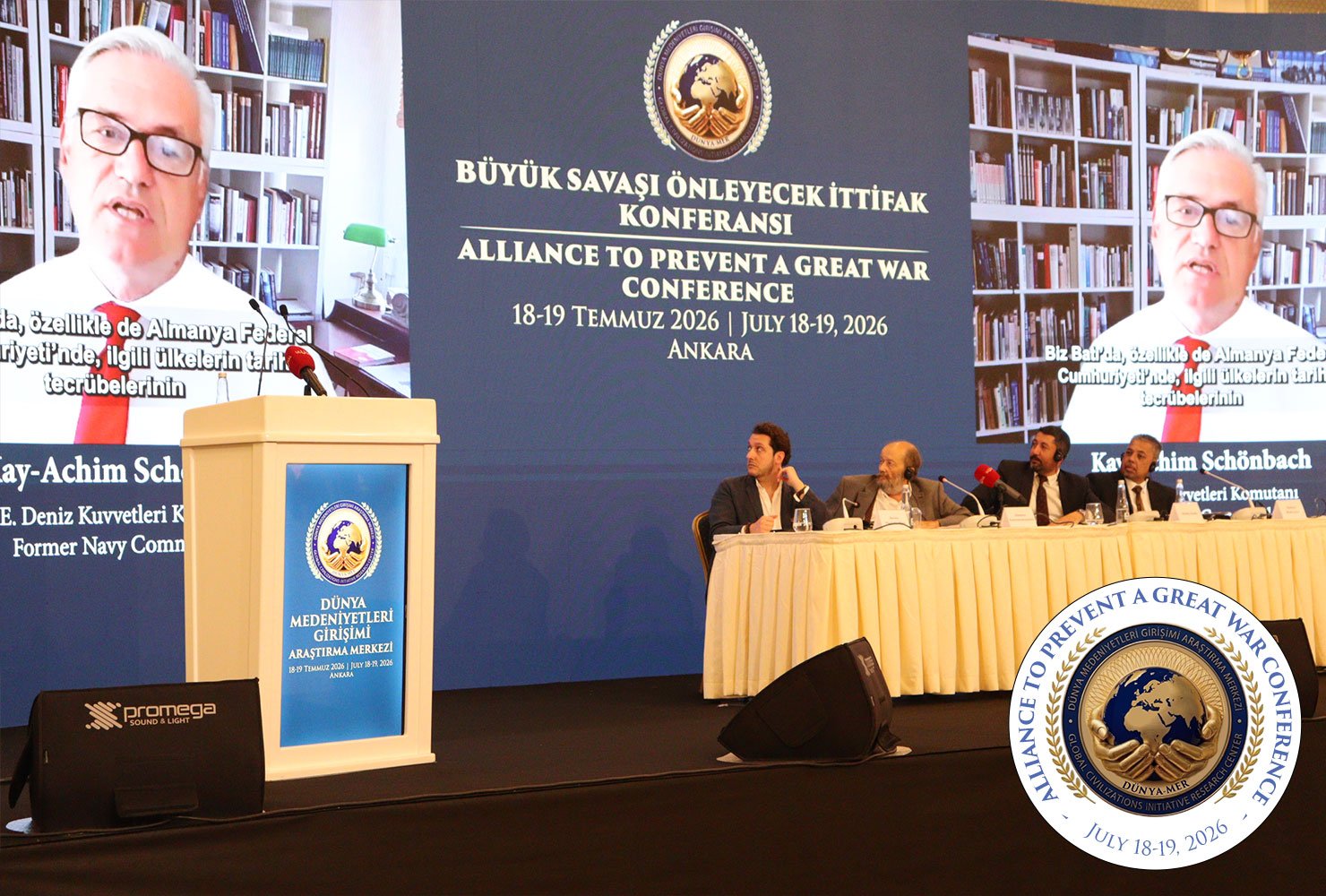
By Kai-Achim Schönbach, ret. Vice-Admiral of the German Navy
The international conference entitled “The Alliance to Prevent a Great War,” organized by the World Civilizations Initiative Research Center, was held at the Meyra Palace Hotel in Ankara on 18–19 July 2026.
UWI will present the speeches held on the conference during the coming days.
The conference, which featured presentations by speakers from Azerbaijan, Belarus, France, Germany, Greece, Iran, Italy, Japan, Russia, the Sahrawi Arab Democratic Republic, South Africa, Spain, Switzerland, the Turkish Republic of Northern Cyprus (TRNC), Türkiye, the United Kingdom, and the United States, was attended by approximately 200 distinguished invited guests.
Ministers, members of parliament, ambassadors, retired generals, scholars, politicians, diplomats, military officers, and experts examined the question of the “Alliance to Prevent a Great War” from a wide range of perspectives.
Below, we present the speech of Kai-Achim Schönbach. Schönbach is retired Vice-Admiral of the Germany Navy. The title was set by UWI.
Unfortunately, I am unable to be among you in person today. I would especially like to express my deep regret for being deprived of the opportunity to exchange ideas with you face-to-face. For those who do not know me, I would like to introduce myself. My name is Kay-Achim Schönbach. I am a retired Vice Admiral of the German Navy, and my final active post was serving as the Chief of the German Navy until 2022.
At this point, saying that we live in turbulent times would merely be stating the obvious. However, looking at it particularly from my perspective as a German—since I do not have the opportunity in this brief greeting to go into lengthy detail about the major shifts in power and realignments shaping foreign policy, security policy, geopolitics, and foreign trade policies—I will focus on the conflict I consider most paramount as a German and a European: the war in Eastern Europe and Ukraine.
My personal and professional background has tied me very closely to the war between Ukraine and the Russian Federation. Indeed, throughout my years of active service and certainly today, I have worked intensively on developments in Eastern Europe and on issues concerning the Russian Federation and Ukraine. Additionally, I served in positions advising senior political decision-makers within the Federal Ministry of Defense of Germany on political and military matters.
Yet, if we have learned any lesson from all these conflicts, it is this: We in the West, particularly in the Federal Republic of Germany, have forgotten how deeply the historical experiences of the countries involved—and more importantly, the political interpretation of history—affect daily politics. We still tend to believe that history ended on May 8, 1945, the day World War II came to an end. Furthermore, with a typical German approach, we think we know best how to confront history, how historical processes should be evaluated, and how the past ought to be reckoned with. The war in the Donbas region in particular has shown us that disregarding historical background and refusing to examine the causes of conflict more deeply and, above all, impartially, was one of the primary drivers that made the emergence of this armed conflict possible.
The war in Eastern Europe could have been prevented. We know this; we all know it. Based on my own experience, I can comfortably say today that diplomacy based on mutual respect and conducted among equals offered all the necessary means to prevent this ongoing conflict from escalating into a full-scale war. And I do not believe I am the only one holding this view. Responsibility for the outbreak of a war or the cause of any conflict in the world can rarely be attributed to a single side alone. It takes two sides for a dispute to arise. In saying this, I am not taking anyone’s side, just as I didn’t in the spring of 2022.
However, we must all accept that powerful actors within the international system had sufficient opportunities to resolve this conflict. Perhaps complete consensus on every detail might not have been achieved, but it was possible to prevent the conflict from spiraling out of control. Regrettably, ignorance, the failure to learn from history, power politics, and flawed risk assessments transformed this cold conflict into a hot war.
My personal concern—and I believe this concern should weigh heavily upon you as well—is that the parties to the conflict might further escalate an already extremely dangerous situation due to their failure to assess the circumstances accurately and their overestimation of their own capacities. In particular, we must acknowledge that we are caught in a dilemma. On one hand, Article 51 of the United Nations Charter provides for rendering support to a country under attack—which, in this case, is undoubtedly Ukraine; there is no hesitation about that.
On the other hand, we must also show the courage to assess the situation correctly. And I strongly believe this: For the benefit of everyone in Europe, and perhaps the entire world, we must take the necessary steps to end this war as swiftly as possible, even if complete justice cannot be achieved for one of the parties to the conflict.
You know what I mean. Under the influence of moralism and misplaced idealism, there is a grave danger of the West preparing to drag itself into this war. No matter how much I understand the plight of an attacked nation on the Kyiv side, I would like to emphasize this once again: The overall well-being and security of the continent is a far greater and more vital value than the indefinite continuation of this war, which, under current conditions, neither side appears capable of winning.
I send my warmest regards to you all. God bless you.