


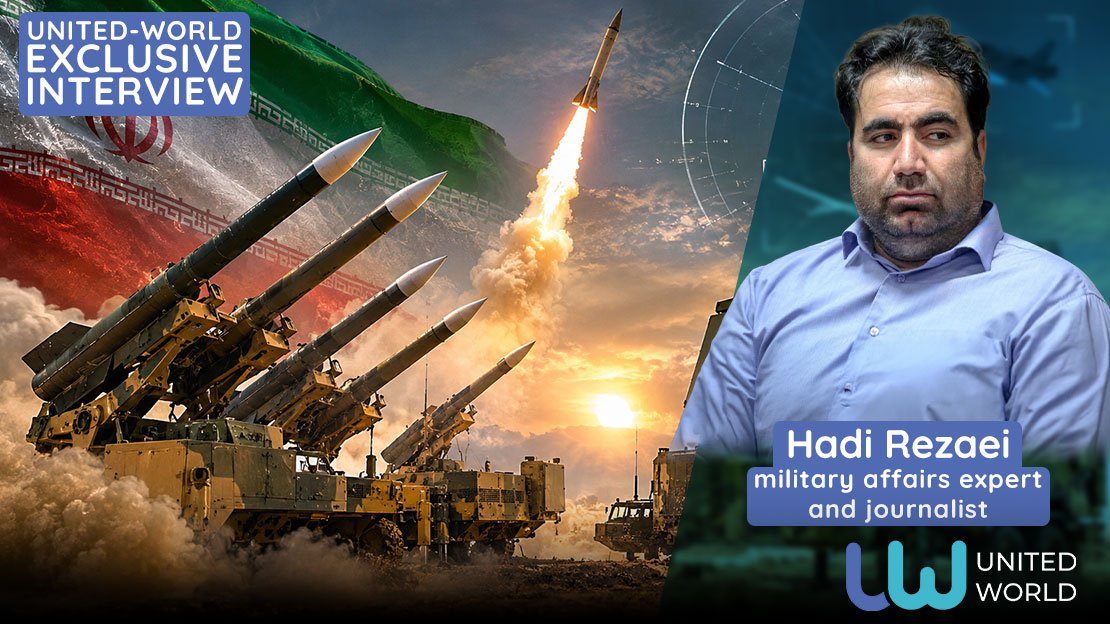
By Azar Mahdavan, from Tehran / Iran
Recent military developments and the experience of past conflicts have raised important questions about Iran’s defense capabilities, the armed forces’ readiness to confront emerging threats, and the evolution of the country’s military strategy. Issues ranging from the future of Iran’s missile and air defense capabilities to its response to potential US and Israeli attacks and the protection of strategic infrastructure have taken on greater significance. Against this backdrop, we spoke with Hadi Rezaei, a military affairs expert and journalist.
To begin, could you explain why Iran has invested more heavily in the development and production of ballistic and cruise missiles in recent years, while paying less attention to the domestic production of advanced fighter aircraft? Is this approach related to the difference in the deterrent capabilities and effectiveness of these two types of military weapons?
Hadi Rezaei: No. I do not think this issue can be explained solely by the difference in the deterrent capabilities of missiles and fighter aircraft. Several factors have led Iran to pursue the development of ballistic and cruise missiles at different stages, and today, the country’s capabilities are more evident in the missile field than in the fighter aircraft sector.
To understand this, we need to go back to the eight-year Iran-Iraq War. At that time, the Iraqi Ba’athist regime under Saddam Hussein launched what became known as the War of the Cities, using the missiles at its disposal to target Iranian cities. These attacks inflicted enormous human and financial losses on Iran. Many of our fellow citizens were killed, while residential areas and urban infrastructure sustained extensive damage.
Under those circumstances, Iran concluded that it needed long-range ballistic missiles to respond to Iraq’s missile attacks and deter further strikes on its cities. These missiles would enable Iran to target sensitive and military installations deep inside Iraqi territory and increase the cost of continuing such attacks for Saddam Hussein.
This operational necessity initially drove Iran to seek missile supplies from abroad, including through purchases from Libya. Subsequently, particularly during the final years of the war, efforts began to reverse-engineer these weapons and develop an indigenous missile production capability. In fact, the emergence of Iran’s missile industry was largely rooted in a genuine operational need and the country’s direct experience of war.
At the same time, Iran’s air force was in a different position. Before the Islamic Revolution, Iran had one of the region’s most well-equipped air fleets, with advanced aircraft such as the F-14, F-4 and F-5 serving in the Air Force of the Iranian Army. Despite severe restrictions on access to spare parts and equipment, Iranian pilots and air force specialists achieved remarkable results during the war and repeatedly demonstrated their capabilities against the Iraqi Air Force.
For this reason, the country’s immediate strategic need at that time was felt more acutely in the missile sector. However, the air force also faced shortages of spare parts and equipment, as well as the challenge of maintaining its operational readiness. These difficulties laid the groundwork for the Air Force’s self-sufficiency initiative. Following an order by Imam Khomeini and a proposal by Ayatollah Khamenei, who was president at the time, efforts began to achieve self-sufficiency, carry out major overhauls and establish domestic spare-parts manufacturing capabilities within the Air Force.
After the war ended, investment in the missile sector increased further. Iran made extensive efforts to develop both ballistic and cruise missiles and achieved significant progress in these fields.
The situation in fighter aircraft production, however, is somewhat different. Developing an advanced fighter jet is considerably more complex and requires a much broader technological and industrial base than the production of many other weapons systems. Building an advanced fighter involves far more than designing the airframe and manufacturing an engine. It requires access to a wide range of technologies, including advanced engines, radar systems, electronic warfare capabilities, avionics, flight-control software, air-launched weapons, and guidance and control systems.
Even acquiring some of these technologies does not necessarily mean that a country can produce a fifth-generation fighter. Globally, the development of advanced fighter aircraft generally requires cooperation among multiple companies and countries, as well as an extensive industrial supply chain.
Iran has undertaken various initiatives in aircraft design and manufacturing over the years, and these efforts should not be overlooked. However, the reality is that the achievements in this sector cannot be compared with the progress Iran has made in its missile industry. Sanctions, restrictions on technology transfers and difficulties in obtaining advanced equipment have also played a role.
What I want to emphasize, however, is that I do not see missiles and fighter aircraft as competing alternatives. They are complementary military capabilities, and both are essential to the country’s defense.
During the 12-day war and the 40-day war, we clearly recognized the importance of having a powerful air force and advanced fighter aircraft. Iran’s missiles also demonstrated their effectiveness and deterrent potential in both conflicts. Therefore, it would be wrong to conclude that because missiles provide deterrence, there is no longer a need for fighter aircraft, or that this is why Iran prioritized missile development.
In fact, for Iran to use its missile capabilities with greater confidence, it also needs a powerful air force. Protecting missile infrastructure, underground missile facilities, production centers and weapons depots requires capable air defense and interceptor fighter aircraft that can counter enemy air attacks.
Therefore, missiles and fighter aircraft are not separate or competing capabilities. Together, they can significantly strengthen the country’s deterrent power. In my view, one of the most important lessons of the recent wars is precisely the need to focus simultaneously on missile capabilities and the modernization of Iran’s air force.
According to statements by Iranian military officials, approximately 260 enemy aircraft were shot down during the Third Imposed War, with a wide range of advanced fighter jets, including the F-35, F-15 and F-16, reportedly among the aircraft targeted. Compared with Iran’s performance during the 12-day war, these figures are considered significant and indicate an improvement in its defensive and operational capabilities. What accounts for this difference? Which factors have enabled Iran’s armed forces to become more effective in confronting the enemy’s advanced military equipment and fighter aircraft?
Hadi Rezaei: To understand why Iran’s air defense performance differed between the Third Imposed War and the 12-day war, and how its ability to counter advanced fighter aircraft improved, we first need to consider an important point.
The 12-day war and the subsequent 40-day war represented very different and unprecedented experiences in terms of the nature of military operations and the methods the enemy employed to confront Iran’s defensive structure. In my view, one of the defining characteristics of these conflicts was the enemy’s use of a combination of warfare methods that went far beyond conventional air strikes.
During the 12-day war, one of the enemy’s first targets was Iran’s air defense network. The enemy understood that, in order to establish air superiority and pave the way for subsequent attacks, it first had to weaken the country’s air defense capabilities.
To this end, in addition to attacking major air defense and radar systems, the enemy used drones and small unmanned aerial vehicles. In some cases, these were launched from inside Iranian territory, including areas near military and air defense facilities, and used to target air defense installations and infrastructure. In other words, the enemy sought to disrupt Iran’s defense network through a combination of internal operations, drone attacks, electronic warfare and air strikes.
Systems such as Bavar, 3rd Khordad and the S-300 were also involved in this confrontation with emerging threats. Naturally, when large, well-known air defense systems come under attack and some of their detection and engagement capabilities are damaged, the effectiveness of the overall defense network can be affected, particularly during the initial stages of a war.
This experience was extremely important for Iran’s armed forces because it demonstrated that relying on large, fixed systems with clearly identifiable geographical locations could create vulnerabilities when facing an adversary equipped with precise intelligence and advanced weapons.
However, what proved significant was that the armed forces used the experience of the 12-day war to reassess and restructure their air defense capabilities.
The period between the 12-day war and the 40-day war provided an opportunity to examine weaknesses, revise certain methods and draw on the expertise of the country’s specialists, engineers and scientists. Based on statements by military commanders and officials, efforts were also made during this period to introduce new innovations and improve the effectiveness of defensive systems.
One of the most important changes was a greater emphasis on more agile, compact and mobile systems. These systems could be deployed under different operational conditions and were less dependent on large, fixed infrastructure.
Previously, a significant proportion of Iran’s air defense systems had been deployed at designated sites, with relatively fixed radar and operational configurations. This allowed the enemy to identify the locations of some of these installations through intelligence and reconnaissance operations and include them among its initial targets.
However, the experience of the 12-day war demonstrated that confronting emerging threats required greater flexibility in the air defense structure. As a result, the use of mobile, smaller and more diverse systems alongside radar and air defense networks became increasingly important.
Another important factor was the use of battlefield experience and the rapid adaptation of technologies to operational conditions. In modern warfare, possessing advanced equipment alone is not decisive. The speed of threat detection, information transfer, decision-making and the effective use of available capabilities are also extremely important.
For this reason, I believe the reported difference in performance between the two wars was primarily the result of accumulated experience, the creativity of the armed forces, improvements to the defense structure and the use of indigenous technologies.
However, we should also be careful when discussing the figure of 260 aircraft announced by military officials. This figure should be considered within the context of official military statements, and not all the aircraft included in it should be regarded as manned fighter jets. The figure also encompasses various types of drones and other military aircraft.
Regardless of the figures, what matters is that the recent wars demonstrated that even the world’s most advanced fighter jets, such as the F-35, are not absolutely invulnerable. Stealth technology does not mean invisibility. If a country can modernize its defense structure in response to evolving threats, it can also improve its ability to counter advanced enemy equipment. This is what Iran demonstrated during the 40-day war, when it was able to track and shoot down some of these advanced stealth aircraft.
One issue that has recently attracted attention in international media is the possibility of submarine internet and international communications cables being targeted. In the event of another war, does Iran have the technical and military capability to target these infrastructures? Furthermore, in light of recent developments, could you explain Iran’s new military tactics and its strategy for preparing for and countering a potential attack by the United States and the Israeli regime?
Hadi Rezaei: Regarding submarine internet cables, it should be noted that whenever a physical infrastructure is accessible and identifiable, the possibility of damaging it also exists. This is not an unattainable objective. Given its geographical position and maritime capabilities, Iran also has the capacity to take effective action in this area.
As we have seen in recent months, some individuals and analysts have also discussed the possibility of these cables being targeted in the event of a new conflict. However, we must distinguish between possessing the potential capability to carry out an operation and successfully conducting a specific operation.
In my view, however, the more important issue raised by this question is the change in Iran’s military approach to potential threats from the United States and the Zionist regime.
What can be inferred from the recent statements made by the Leader of the Islamic Revolution during his meeting with military commanders is that Iran’s military approach has entered a different phase compared with the past. One of the most important elements of this shift is the emphasis on a response extending beyond the region.
In other words, in the past, much of the enemy’s strategic calculations were based on the assumption that if Iran were attacked, Tehran’s response would largely remain confined to the region and focus on US military bases there. Today, however, this assumption can no longer serve as a reliable basis for their calculations.
Iran has declared that any renewed aggression will be met with a different and broader response, one that will not necessarily be limited to the same framework witnessed during the 12-day and 40-day wars. This gives the armed forces greater flexibility in using various capabilities and sends a warning to the enemy that it cannot predict or restrict the scope of Iran’s response by defining a specific geographical area.
During the 40-day war, we also witnessed how the targeting of US military bases in the region and certain facilities linked to American interests affected the dynamics of the conflict and increased the costs of the war for the opposing side. Ultimately, the United States sought to bring the confrontation to an end and establish a ceasefire.
In my view, this experience demonstrated that expanding the costs of war for the opposing side is one of the key components of Iran’s deterrence strategy.
There is another point that needs to be considered. Countries do not usually disclose their military tactics in full or reveal all their operational details. Some capabilities and methods must remain unknown to the adversary in order to preserve the element of surprise.
In recent days, Mohsen Rezaei, Secretary of the Supreme National Security Council, has also referred in his statements to the existence of methods, tools and tactics that could take the enemy by surprise. This is significant from a military perspective because, in warfare, the side with superior equipment does not necessarily have the upper hand. Initiative and the fact that some operational capabilities remain undisclosed can also play an important role in changing the balance of power.
Overall, a response extending beyond the region, attention to the strategic infrastructure and interests of the opposing side, and the use of various military capabilities are among the key elements that have become increasingly prominent in Iran’s defense calculations.
Over the past two months, US officials have repeatedly referred to the possibility of targeting Mount Kolang. Iranian officials, meanwhile, have stressed that any action against this area would trigger a strong response from Iran. Why has this mountain recently attracted so much attention in statements by US officials and reports in foreign media, despite having received relatively little attention in the past? Should this increased focus be viewed as part of America’s media campaign and psychological warfare against Iran, or does the site also have particular military and strategic significance?
Hadi Rezaei: In my view, to answer this question, we must first examine the nature and function of the complex located in the Mount Kolang area.
The primary importance of Mount Kolang lies in the structures and facilities associated with Iran’s nuclear program. The area has scientific, technological and research significance and is connected to infrastructure that could play a role in sustaining Iran’s strategic nuclear activities.
Therefore, contrary to some interpretations, the significance of Mount Kolang should not be viewed solely in military terms. Its connection to Iran’s scientific, research and nuclear capabilities is the more important consideration.
Over the years, the United States and the Zionist regime have sought to weaken Iran’s nuclear infrastructure through political pressure, sanctions and, in some cases, acts of sabotage and military operations. Within this context, it is natural that new facilities or complexes capable of preserving and sustaining the country’s nuclear capabilities would attract their attention.
The geographical location and underground structure of this complex have also contributed to the increased attention it has received from Western media and military circles. When a facility is constructed inside a mountain and deep underground, it naturally becomes significant in terms of physical protection and the increased difficulty of carrying out an air strike against it.
As for whether the increased focus on Mount Kolang is purely a psychological operation or also reflects its strategic importance, I believe both factors are involved.
The Americans are certainly pursuing psychological and propaganda objectives by repeatedly mentioning this site and threatening to target it. They want to convey the message that none of Iran’s strategic infrastructure, not even facilities built deep inside mountains, is beyond their reach or outside their surveillance.
At the same time, these threats demonstrate that Mount Kolang is strategically important to Iran and that the enemy is aware of its function and significance.
For this reason, I believe the issue should not be reduced to psychological warfare alone. This area is important to the country from scientific and nuclear perspectives, as well as in terms of strategy and national security.
Naturally, any threat against such a complex would provoke a response from Iran. The central point is that the United States must understand that an attack on Iran’s strategic infrastructure would not simply constitute an isolated strike against a geographical location; it could have much broader consequences.
In a recent message addressed to the commanders of Iran’s armed forces, the Leader of the Islamic Republic emphasized the need to disregard geographical boundaries and respond to threats before any attack takes place. The army’s spokesman, Brigadier General Akramnia, also referred to this issue yesterday. What is the military and strategic significance of these statements? Can they be interpreted as a sign of the emergence or beginning of a new military doctrine in Iran, emphasizing a pre-emptive approach to confronting threats?
Hadi Rezaei: In my view, this is one of the most important strategic messages emerging from recent developments, and it should not be regarded merely as a military statement or warning.
What the Leader of the Islamic Revolution emphasized in his message to the commanders of the armed forces points to the need to change the way threats are addressed and reassess certain aspects of the country’s defense calculations.
In fact, recent wars have demonstrated that before launching a large-scale attack, an adversary may use a combination of intelligence operations, sabotage, electronic warfare, cyber operations and limited strikes to weaken a country’s defensive capabilities. Under such circumstances, simply waiting for an attack to take place before responding can impose significant costs on the country.
That is why the emphasis on responding to threats quickly and effectively has become particularly important.
Here, however, we need to distinguish between two concepts: pre-emptive action and preventive action. Pre-emptive action refers to confronting a threat when credible and serious indications suggest that an attack is imminent. Preventive action, by contrast, may be undertaken to prevent a potential threat from emerging in the future, even in the absence of indications that an attack is imminent.
Therefore, my interpretation of the recent statements by military commanders is not that Iran intends to initiate a war or launch an attack in the absence of a threat. Rather, the point is that the armed forces must not allow the enemy to seize the initiative through preliminary operations and then place Iran in a reactive position after inflicting damage.
Another important point is the emphasis on responses that are not geographically confined. In modern warfare, threats do not necessarily originate from a single location or a specific military base. Countries rely on networks of bases, support centers, military infrastructure and logistical capabilities spread across different locations.
Therefore, when a response without geographical limitations is discussed, the message is that the enemy should not assume that simply by deploying its equipment and capabilities outside Iran’s borders, it can shield them from the consequences of an act of aggression.
The recent remarks by the army’s spokesman regarding a shift toward a more offensive military doctrine can also be understood within this framework.
In my view, one point needs to be emphasized here: a more offensive military doctrine does not necessarily mean abandoning the defensive nature of the armed forces. The Islamic Republic of Iran continues to maintain that it will not be the party to initiate a war. However, this does not mean accepting passivity in the face of threats.
The difference is that, under the emerging approach, defense is no longer defined solely as repelling an attack within the country’s borders. Preventing threats from materializing and increasing the costs of aggression have also become important elements of defense planning.
I believe the 12-day and 40-day wars played a significant role in shaping this outlook. These two experiences demonstrated that if the enemy believes it can disrupt Iran’s defensive structure through a large-scale attack and subsequently maintain control over the scope of the conflict, it may be making a serious miscalculation.
For this reason, greater emphasis is now being placed on response speed, operational initiative, combat readiness and updating the armed forces’ understanding of the enemy’s capabilities.
Another important consideration is the decisive role of intelligence and reconnaissance in such a doctrine. For a country to respond to threats in a timely manner, it must have an accurate understanding of the opposing side’s capabilities, movements and potential targets. Without accurate intelligence and coordinated command and control, even advanced military equipment cannot guarantee success.
Therefore, I view the recent statements by the Leader of the Islamic Revolution and military commanders as an indication that Iran is moving toward a more active model of deterrence. Under this model, a country’s defensive strength is measured not only by its ability to repel an attack, but also by its capacity to prevent aggression, respond rapidly and impose heavy costs on the aggressor.
This also means that restrictions on operational range have effectively been removed.
Ultimately, the message of this shift to the United States and the Zionist regime is clear: if they believe they can once again launch a military operation against Iran and determine the scope, geographical boundaries and timing of the end of the war themselves, they need to reconsider their calculations.
Iran has declared that any renewed aggression will be met with a response that could differ significantly from previous responses and extend beyond the frameworks established in earlier conflicts.